


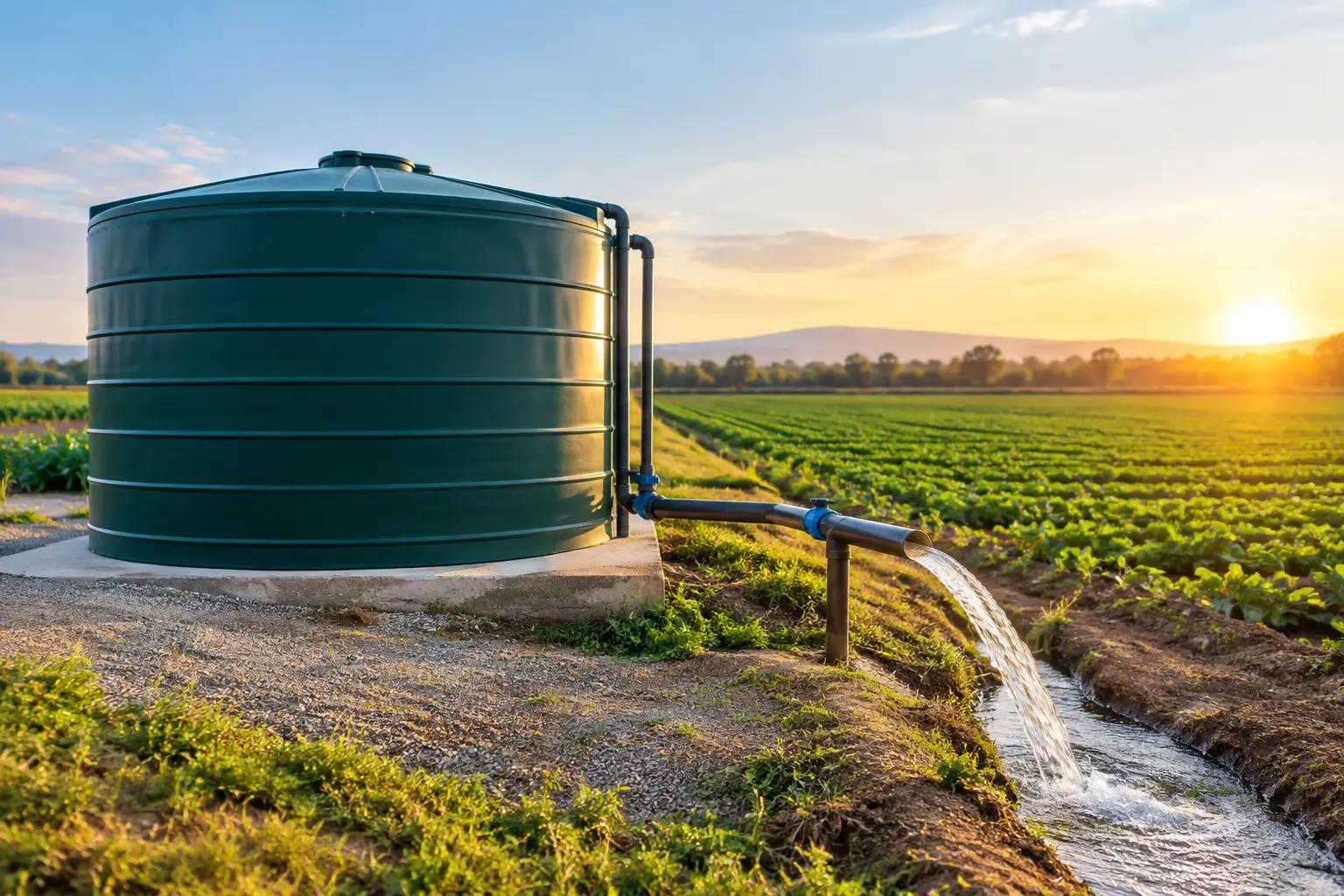
A dry spell does not usually expose a water problem all at once. It starts with a trough that takes too long to recover, an irrigation run cut short, or a pump that cannot keep up at the far end of the property. Well-planned agricultural water storage gives you a reserve between rainfall, deliveries and demand – and that reserve can make daily farm work far more manageable.
For Australian farms, acreage blocks and rural businesses, storage is not just about buying the largest tank that will fit. The right system needs to match your water source, livestock numbers, irrigation requirements, site conditions and the way you need water to move around the property. Get those decisions right early and you can reduce reliance on carted water, protect stock supply and make better use of every decent fall of rain.
Start with the job your water needs to do
Before choosing tank capacity or material, separate the uses of water on your property. A tank supplying a house, a few cattle troughs and a garden has a very different duty from one feeding an irrigation pump, wash-down area or fertiliser mixing operation.
Livestock water is generally a daily, non-negotiable demand. Allow for seasonal changes too, as stock drink more during hot weather and numbers can increase during lambing, calving or finishing periods. Irrigation demand is less constant but can be much larger in a short window. If a pump runs for several hours, the available tank volume and refill rate must support that run without leaving other essential uses short.
It is also worth deciding which water uses need clean rainwater and which can use dam, bore or recycled water where appropriate. Keeping potable household supply separate from stock, irrigation or wash-down storage makes system management simpler and helps protect water quality.
Measure supply as well as demand
Rainwater harvesting can be a valuable farm resource, particularly from large shed, dairy, workshop and machinery-shed roofs. Roof catchment area, local rainfall and the reliability of seasonal rain determine how much can realistically be collected. A large roof can fill a substantial tank quickly in a storm, but it cannot guarantee supply through a long dry period.
Bore and dam water change the equation again. A bore may have a limited sustainable yield, while a dam level can fall sharply during a dry summer. Storage gives these sources time to recover and lets a lower-flow source fill a tank between higher-demand periods. For many properties, a combination of rainwater collection, stored bore water and a contingency supply is the most practical approach.
Choosing agricultural water storage capacity
There is no single tank size that suits every rural property. Capacity should be based on the number of days you need to carry through without dependable replenishment, not simply the amount of spare space beside the shed.
For stock water, calculate expected daily consumption, then build in an allowance for hot weather, leaks, float-valve issues and periods when access or power may be interrupted. For irrigation, calculate the litres required per watering cycle and consider whether the tank is intended to supply the full cycle or supplement another source.
One large tank can be economical, but several tanks often give better operational flexibility. You may be able to dedicate one tank to the home, one to livestock and another to irrigation. Multiple tanks also allow staged expansion as the property changes, and a problem with one tank does not necessarily take your whole water supply offline.
A useful rule is to size storage for the consequence of running out. Where water is readily available from a reliable town supply, a smaller backup tank may be sufficient. On an off-grid farm where troughs and the house depend on stored water, a larger reserve is usually worth the investment.
Match the tank to the site and application
Poly and steel AquaPlate tanks are both proven choices for agricultural applications, but each suits different priorities. Poly tanks are popular for their corrosion resistance, broad range of shapes and straightforward installation. They are often a practical option for rural homes, stock water, sheds and areas where access is limited.
Steel tanks offer high capacity and can be a strong choice where a large footprint and long-term bulk storage are required. Tank material, liner quality, outlet configuration and roof water collection setup all matter. A tank is only as useful as its fittings, foundation and ability to connect cleanly to the rest of the system.
Site preparation should not be treated as an afterthought. Tanks need a level, stable base that supports the full weight of stored water. One litre weighs one kilogram, so even a modest rural tank carries a serious load when full. A poorly prepared base can affect tank performance, plumbing connections and warranty requirements.
Think about vehicle access as well. Can a delivery truck reach the site? Is there enough room to position the tank safely? Will you still be able to inspect outlets, clean gutters and service the pump after installation? These practical details save time and extra costs later.
Do not overlook water quality
Water for stock, irrigation and household use has different quality requirements. Rainwater tanks collecting from sheds benefit from leaf screens, first-flush devices and sealed lids to reduce sediment, insects and organic matter entering the supply. Regular gutter cleaning is particularly worthwhile around trees, as blocked gutters can limit collection when rain finally arrives.
For household drinking water, consider the complete treatment path. A suitable pump, sediment filtration and, where needed, carbon or UV filtration can help deliver cleaner water at the tap. Filters need ongoing cartridge changes, so choose a system with readily available replacement cartridges and service kits rather than treating filtration as a one-off purchase.
If water is being stored for chemicals, fertiliser, molasses or other industrial products, use a purpose-designed tank. Do not repurpose a standard rainwater tank without confirming material compatibility, fittings and safety requirements.
Pumps and pipework decide how useful storage is
A full tank is not much help if the pump cannot deliver the required pressure and flow. Farm and irrigation pumps need to be selected for the job at hand: the height water must be lifted, the distance it travels, the pipe size, the number of troughs or sprinklers running, and the flow rate required at the outlet.
Undersized pipework can restrict a capable pump, while an oversized pump can cycle excessively or create unnecessary pressure issues. Long runs to paddocks need careful sizing, especially where elevation changes are involved. A sensible layout may include separate lines or zones, allowing domestic water, stock troughs and irrigation to operate without competing for the same flow.
Pressure pumps are well suited to household and shed supply, while dedicated farm or irrigation pumps may better suit larger flow requirements. Where rainwater supplements mains water at a home, a rain-to-mains switch can provide automatic backup when tank levels are low. This keeps the household supplied while preserving a clear separation between stored rainwater and mains water.
Consider power reliability too. A pump dependent on mains power may leave you without water during an outage unless you have backup power or gravity-fed storage. Fire preparedness is another reason to plan carefully. A dedicated fire tank, compliant fittings and a suitable fire pump can provide a more dependable emergency reserve than relying on general-purpose storage that may be depleted in summer.
Build in maintenance and room to grow
Agricultural water systems work best when they are easy to check. Fit accessible isolation valves, use clear labelling where several lines are involved, and position outlets where sediment can be flushed when needed. Check tank screens, overflows, gutters, pump strainers and trough float valves regularly. A small leak at a trough can waste a surprising amount of stored water over a season.
Plan for expansion where possible. A spare tank connection, larger pipe from the start, or a pump with enough capacity for one additional trough line can avoid a costly redesign later. It is often cheaper to allow for future growth while machinery and contractors are already on site.
Central Coast Water Tanks has been trusted for over 30 years, with quality tank, pump, filtration and accessory options that make it easier to put together a complete system from coast to country. Whether you are supplying a few troughs or building a larger farm water setup, choosing compatible components from the outset helps avoid expensive compromises.
The best time to assess your storage is before the next dry period, not when the tank level is already falling. Start with the water you cannot afford to lose, then build a system that gives your property a practical reserve when it counts.