

Choosing the right water pump can make a big difference to the performance of your rainwater or irrigation system. However, the biggest pump is not always the best pump.
A house pressure pump beside a rainwater tank has very different requirements from a pump drawing water from a bore, dam or well. Therefore, when comparing a submersible vs surface pump, you need to consider the water source, required pressure, pipe distance and how the water will be used.
Whether you’re supplying a Central Coast home, rural property, garden or irrigation system, choosing the right pump from the beginning can provide better pressure, improved reliability and fewer maintenance problems.
What Is the Difference Between a Submersible and Surface Pump?
The main difference is where the pump operates.
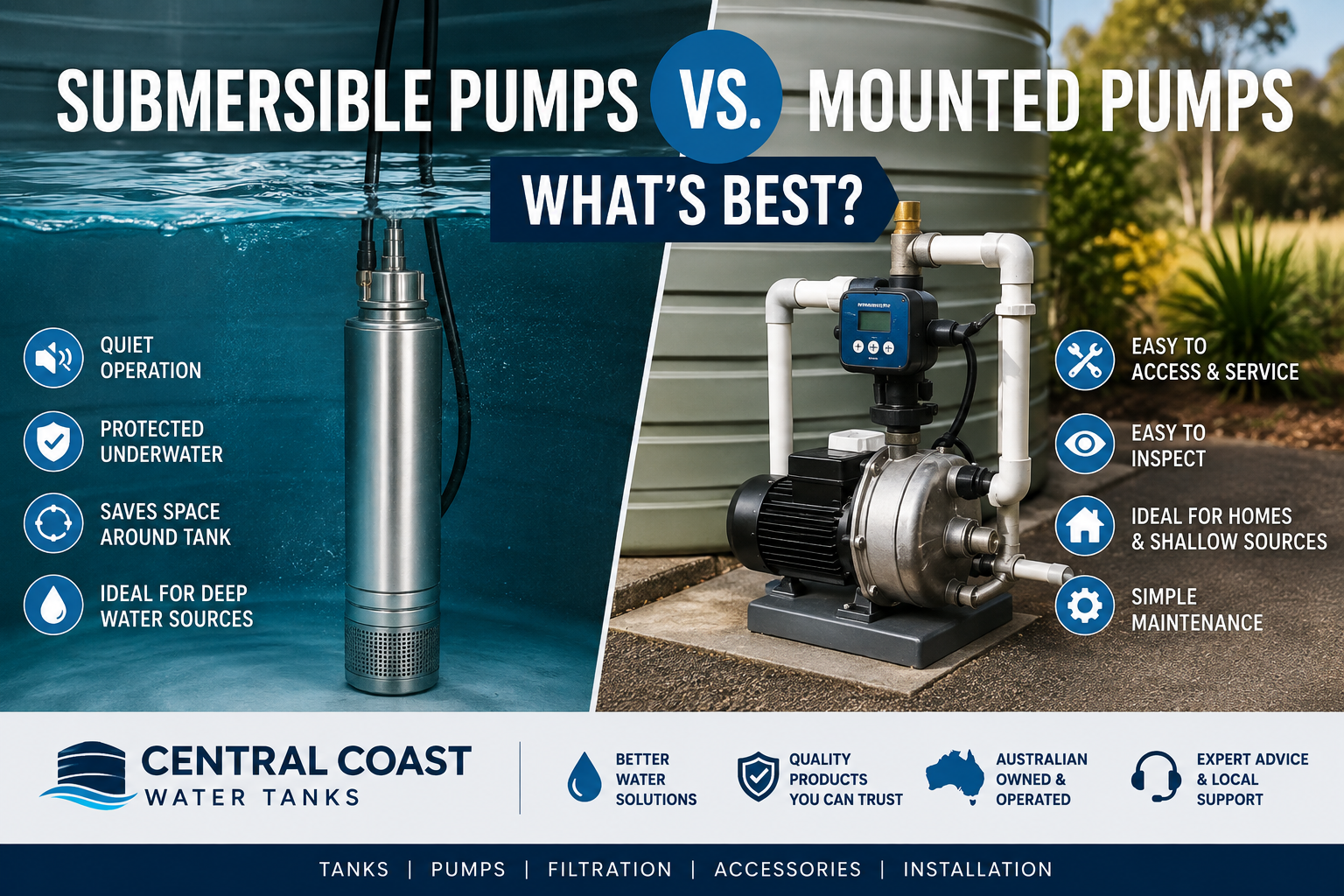
A submersible water pump operates below the water level. Depending on the model, it may be installed inside a rainwater tank, bore, well, sump or other suitable water source.
Instead of pulling water towards itself, the pump pushes water through the delivery pipe.
A surface pump, also known as an external water pump, operates outside the water source. It draws water through a suction pipe before delivering it under pressure.
Surface pumps are commonly installed next to above-ground rainwater tanks. They can also be housed inside a ventilated pump cover or protected service area.
Both designs have advantages. The best choice depends on the job.
When Should You Choose a Submersible Water Pump?
A submersible pump is particularly useful when the water level is well below the pump’s normal operating position.
Bores and wells are good examples. A conventional surface pump has limits on how far it can lift water through suction. A correctly selected submersible bore pump avoids this problem because it pushes the water from below.
Submersible pumps can also be used in:
- Rainwater tanks
- Bores and wells
- Sumps
- Tank-to-tank transfer systems
- Some dam and irrigation applications
- Rural and agricultural water systems
Another advantage is reduced noise. Because the pump operates underwater, there is generally less pump noise around the house or tank.
In addition, the pump does not take up space beside the tank.
However, servicing can require the pump to be removed from the water source. This is relatively straightforward with some rainwater tanks but can be more involved with deep bores.
When Is a Surface Pump the Better Option?
For many above-ground rainwater tanks, an external surface pump remains a simple and practical solution.
A surface pump can sit close to the tank outlet with a short suction line. As a result, it is easy to access for inspection and servicing.
This type of installation is particularly suitable for:
- Household rainwater systems
- Garden watering
- Toilets and washing machines
- Stock watering
- Tank-to-tank transfer
- Sheds and workshops
- Light irrigation systems
A quality rainwater tank pump can provide reliable pressure throughout the property when correctly sized.
Accessibility is another major benefit. If you need to inspect a fitting, controller or pump, everything is above ground and within easy reach.
For homeowners wanting a straightforward water pump for a rainwater tank, a surface pressure pump is often an excellent starting point.
House Pressure Pumps for Rainwater Tanks
A house pressure pump needs to do more than simply move water.
It needs to provide sufficient flow and pressure when several outlets are operating. For example, you may have a shower running while a toilet cistern refills and the washing machine draws water.
If the pump is too small, pressure can drop noticeably.
On the other hand, simply installing an oversized pump isn’t necessarily the answer. Correct pump selection should match the expected household demand.
A pressure controller, pressure tank or variable-speed system may also form part of the installation.
Dry-run protection is particularly valuable because it can help protect the pump if the rainwater tank runs empty.
Submersible vs Surface Pump for Irrigation
Irrigation adds another consideration.
An irrigation pump needs to provide enough flow while maintaining the pressure required by sprinklers, irrigation zones or other equipment.
A surface pump can work extremely well when drawing from a nearby rainwater tank or suitable shallow water source.
However, a submersible pump may be more appropriate for a bore, well or deeper water source.
The length and diameter of the pipework also matter. Long pipe runs, elevation changes, filters and restrictive fittings all create pressure losses.
Therefore, an irrigation pump should be selected according to the complete system rather than simply its maximum advertised flow rate.
Understanding Pump Flow and Head
Two terms you’ll regularly see when comparing pumps are flow and head.
Flow describes how much water the pump can deliver, normally measured in litres per minute (LPM).
Head describes the pressure or vertical lift the pump can overcome and is generally measured in metres.
This is important because the maximum flow printed on a pump specification isn’t necessarily the flow you’ll receive at your tap or sprinkler.
As pressure and head increase, available flow generally decreases.
Pipe length, pipe diameter, elevation, filters, valves and fittings can also affect performance.
For this reason, choosing a pump based purely on its maximum LPM rating can be misleading.
Don’t Forget the Suction Line
The suction side of a surface pump is particularly important.
Connections need to remain airtight. Even a small air leak can cause problems with priming, water flow and pump performance.
Long suction lines can also reduce efficiency.
Where possible, keep the surface pump reasonably close to the rainwater tank and use correctly sized pipework.
A suitable check valve or foot valve may also be required depending on the installation.
Protecting Your Water Pump
Good installation can significantly improve the working life of a pump.
An external water pump should be protected from harsh weather while still having adequate ventilation.
Electrical connections also need appropriate protection, and electrical work should be carried out in accordance with applicable Australian requirements.
It is also worth designing the system so servicing is easy.
Isolation valves can allow a pump, controller or filter to be serviced without draining the entire rainwater tank.
Good-quality strainers can also help prevent unwanted debris from reaching the pump.
Rainwater Tank Filtration Is Important Too
Your pump is only one component of a good rainwater system.
Leaves, sediment and organic material can accumulate in rainwater tanks over time. Therefore, gutters, leaf screens, tank strainers and first-flush systems should be regularly inspected and maintained.
Where rainwater supplies a home, appropriate water filtration should also be considered based on the source and intended use of the water.
A well-designed system brings the rainwater tank, water pump and filtration system together rather than treating each component separately.
Which Water Pump Should You Choose?
Consider a submersible water pump when:
- Water needs to be pumped from a bore or well
- The water source is too deep for practical surface-pump suction
- You prefer a quieter pump installation
- Space beside the tank is limited
- The application is suitable for an underwater pump
A surface water pump may be the better choice when:
- Your rainwater tank is above ground
- The pump can be positioned close to the tank
- Easy servicing is important
- You need household water pressure
- You’re supplying a garden or irrigation system
- You want straightforward access to the pump and controller
Neither design is automatically better.
The best pump is the one that matches your water source and the job it needs to perform.
Choosing a Rainwater Tank Pump on the Central Coast
Before buying a water pump for your rainwater tank, work out a few basic details.
Consider how far the water needs to travel, the height to the highest outlet and the number of taps or appliances likely to operate simultaneously.
You should also consider pipe size, irrigation requirements and any filters installed in the system.
For rural properties, you may also need to account for stock troughs, sheds, gardens, dams or longer pipe runs.
Taking the time to work through these factors can prevent poor pressure, excessive cycling and premature pump wear.
Need Help Choosing the Right Water Pump?
With more than 30 years of experience in the rainwater tank industry, Central Coast Water Tanks can help you select a pump to suit your tank, home, garden or property.
Whether you need a house pressure pump, rainwater tank pump, surface pump, submersible pump or irrigation pump, choosing the right equipment can make your entire water system perform better.
Central Coast Water Tanks – practical advice for tanks, pumps and rainwater systems.
Submersible vs Surface Pump: