

A dry trough on a hot afternoon is not a minor inconvenience. It can affect stock health, weight gain, milk production and the time you spend driving around the property checking water points. Well-chosen livestock water tanks give you stored capacity between rain events, pump failures and busy periods, so stock have dependable access to clean water where they need it.
For acreage owners and farm operators, the best setup is rarely just a tank placed beside a shed. It is a working system: reliable catchment or bore supply, enough storage for the herd, sensible tank placement, a suitable pump and pipework that can handle daily demand. Getting these basics right up front can save money on water cartage, emergency repairs and undersized equipment.
Start with the livestock and the dry spell
Tank capacity should be based on daily stock demand, not simply the largest tank that fits beside the house or yards. Water use varies with animal type, feed, temperature, pregnancy and lactation. Cattle, horses, sheep, goats and poultry all have different needs, while hot, dry conditions can quickly lift consumption above the usual average.
As a practical starting point, work out how many animals will drink from each water point and estimate their daily use during the hottest likely period. Then allow for the number of days you want stored water to cover. On properties relying mainly on roof runoff, that storage period may need to bridge a long gap between useful rainfall. On a bore-fed system, the tank can provide a buffer that lets the pump run efficiently rather than starting every time an animal drinks.
Do not forget future demand. A tank sized for a small mob today may be inadequate after a change in stocking rates, a new paddock subdivision or the addition of a wash-down area. If the site allows it, installing a larger tank or allowing plumbing capacity for a second tank is often more cost-effective than replacing an undersized system later.
Separate storage from drinking points
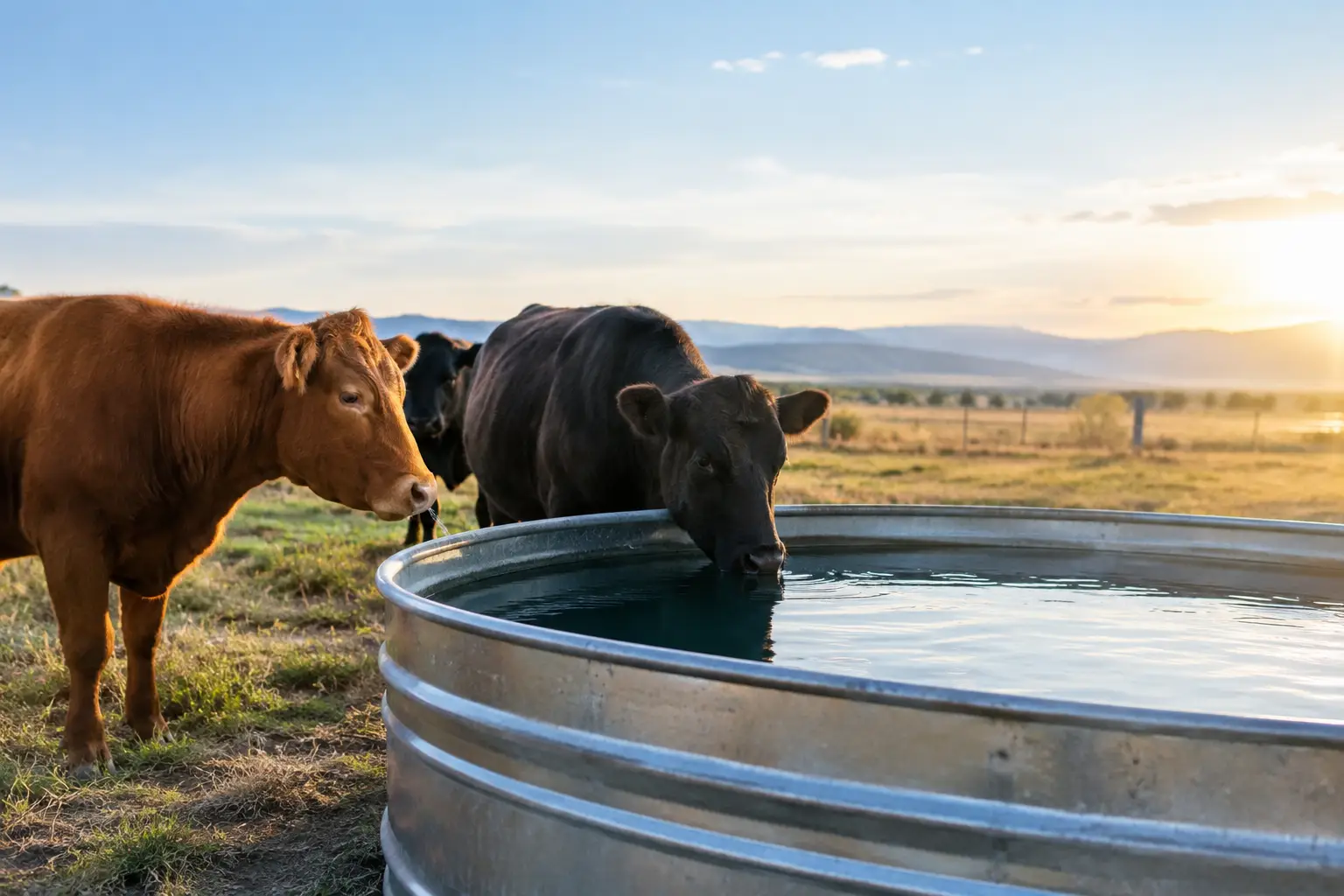
A livestock storage tank and a trough do different jobs. The tank holds the reserve water; the trough provides controlled access in the paddock. Keeping the main tank away from stock reduces the chance of impact damage, contamination and wasted water from animals leaning on fittings or playing with float valves.
A well-planned system usually feeds troughs through buried poly pipe, with isolation valves placed where sections can be shut off for repairs. Float valves maintain the trough level, while a protected overflow directs excess water away from high-traffic areas. This approach makes it easier to find leaks and keeps the stored water cleaner for longer.
Choosing livestock water tanks by material
Poly and steel water tanks are both proven options for Australian rural properties. The better choice depends on your location, access, budget, available footprint and how the water will be collected and used.
Poly water tanks are popular because they are durable, corrosion-resistant and comparatively straightforward to position on a prepared base. They are available in a wide range of round, slimline and low-profile shapes, making them useful near sheds, stables, dairies and machinery areas. A quality UV-stabilised tank is particularly suited to exposed Australian conditions, but it still needs a level, fully supported base and clear access for delivery.
Steel AquaPlate tanks are a strong option where large capacities are required or where a steel tank suits the property layout. Their liner-based construction can make them a practical choice for substantial rural storage, including water collected from large shed roofs. They require proper site preparation and installation, but can provide excellent capacity without taking up excessive ground area.
For either material, buy for the application rather than appearance. Potable-grade storage may be needed where the same supply serves a farmhouse or workers’ accommodation. A dedicated non-potable tank can suit stock, irrigation or wash-down duties. If you need to store fertiliser, molasses, chemicals or other liquids, use a tank specifically designed and rated for that product. A standard rainwater tank is not automatically suitable for chemical storage.
Tank placement affects every part of the system
A tank’s position influences water pressure, pump size, pipe runs, maintenance access and delivery cost. The ideal location is close enough to the collection point or water source to avoid unnecessary pipework, while still allowing easy access for cleaning, inspecting fittings and connecting a water cart if required.
Where gravity can do some of the work, it is worth considering. A tank positioned higher than troughs may reduce pumping demand, though natural fall is not always available on flat country. More commonly, a pressure pump or farm pump moves water from the storage tank to troughs, with the pump selected for the required flow rate, lift and pipe distance.
Keep tanks clear of tree roots and branches, and choose stable ground that will not become waterlogged. A full tank is extremely heavy, so the base must be level, compacted and built to the tank manufacturer’s requirements. Poor preparation can lead to distortion, stress on fittings and problems that are costly to rectify once the tank is full.
Think about vehicle access before ordering. Delivery trucks need a clear route, and larger tanks need adequate room for unloading and placement. On a rural block, the shortest path on a map is not always practical when there are gates, soft ground, overhead lines or tight turns around sheds.
Protect water quality from roof to trough
Clean water supports healthier stock and reduces maintenance at pumps, filters and valves. The first line of defence is stopping leaves, insects, dust and bird droppings from entering the tank. Gutters should be maintained, and roof water should pass through suitable screens and a first-flush device where appropriate.
A tank lid needs to fit securely. Light entering the tank encourages algae, while gaps can allow mosquitoes, rodents and debris inside. Screens on inlet and overflow points help prevent pests entering without restricting ventilation. For open dams or other untreated sources, filtration requirements may be different, particularly if water is also used in the home.
Troughs need attention too. Stock can foul a trough quickly, and a slow leak can waste far more water than expected over a season. Check float valves regularly, clean sediment from troughs and inspect the ground around fittings for damp patches. If one trough seems to empty faster than it should, isolate that line and investigate before the problem becomes a pump or storage issue.
Choose a pump for the job, not the label
A pump described as high-pressure is not automatically the right pump for livestock watering. What matters is whether it can deliver enough water at the end of the longest pipe run, at the elevation of the highest trough, while allowing for friction losses through pipe, valves and filters.
For a simple tank-to-trough arrangement, a farm or irrigation pump may be suitable. Where the system also supplies a house, shed or rain-to-mains arrangement, the setup may need different pressure control and protection. Dry-run protection, a pressure controller and correctly sized pipework can prevent unnecessary pump cycling and extend equipment life.
Solar pumping can be a good solution for remote paddocks, especially where running power is expensive. It does, however, need enough storage to carry the property through cloudy days and overnight demand. In remote systems, spend more time on tank capacity and float-valve reliability than on chasing the smallest possible tank price.
Buy a system that can be serviced
The lowest initial price is only one part of the cost. Consider replacement parts, compatible fittings, cartridge availability where filtration is used, and whether you can isolate and repair a component without taking the whole water supply offline. Established products with readily available accessories are generally easier to live with over the long term.
It also pays to buy the major components together. Matching tank outlets, pump connections, filters, valves and pipe sizes avoids last-minute trips for adaptors and reduces the risk of a weak point in the system. A package that includes the right tank, pump and filtration equipment can offer better value than piecing together mismatched items.
Central Coast Water Tanks has been trusted for over 30 years to help customers match quality products to real water needs, from coastal acreage through to country properties Australia-wide. Shop online and save on tanks, pumps and water-system components selected for practical Australian conditions.
Before the next hot spell arrives, walk the line from your water source to the furthest trough. The right livestock water system should give you confidence that every animal can drink, even when rain has been scarce and the day is already too busy.