


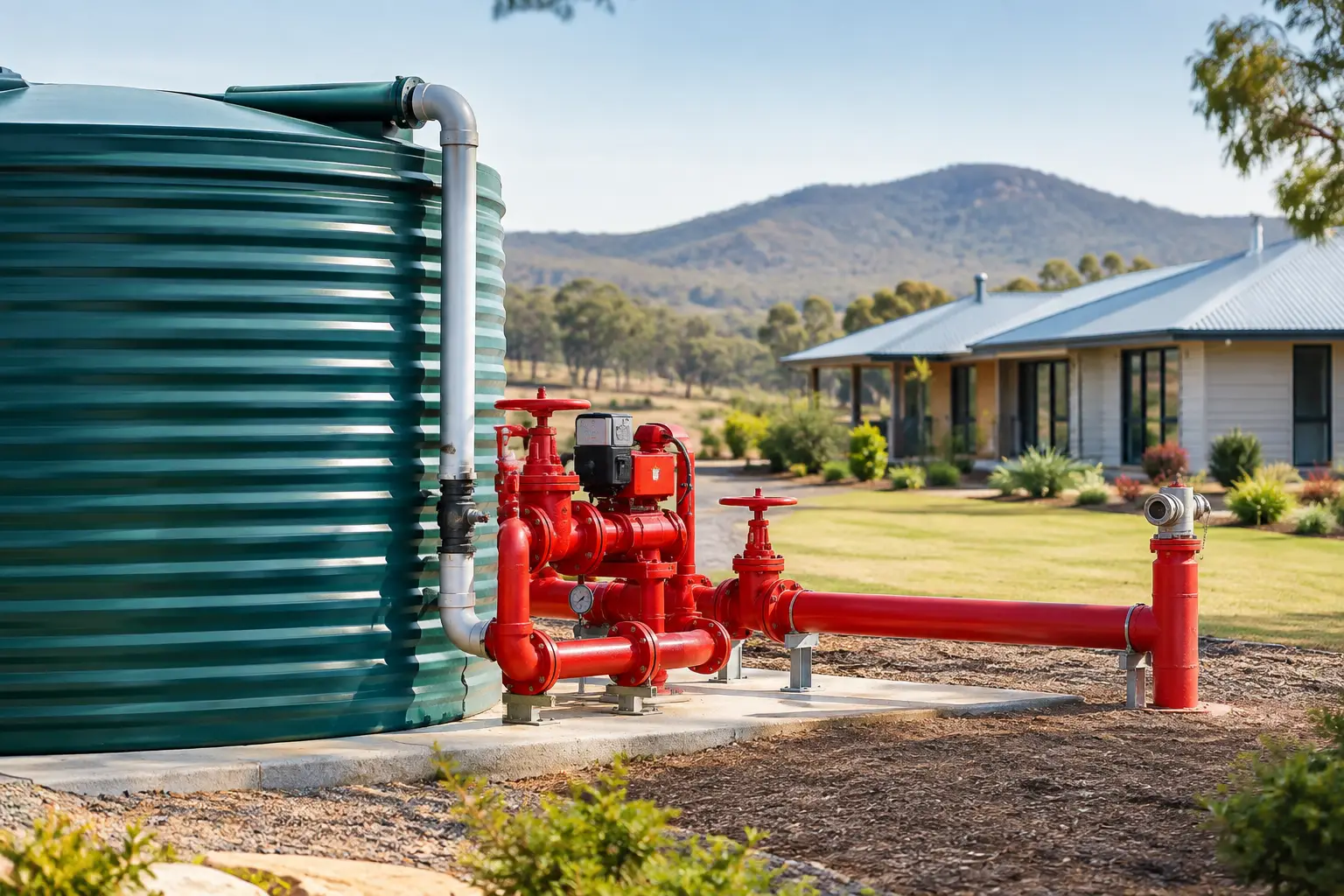
When a bushfire is moving through the district, a water tank that is half empty, inaccessible or connected to the wrong pump is not much of a firefighting asset. This fire water supply guide helps homeowners, acreage owners and rural operators think through the practical parts of storing and moving water when it matters most.
A suitable system is not simply the biggest tank your block can fit. It is a combination of dependable stored water, clear vehicle access, compatible fittings, a pump that can deliver useful pressure and a layout that people can operate under pressure. Local bushfire planning requirements vary, so always confirm the current advice from your state fire authority, council, insurer and building professional before selecting equipment or relying on a system for compliance.
Start with the fire risk on your property
Properties on the Central Coast hinterland, through the Hunter and across rural NSW can face very different fire conditions. A suburban home beside reserve land has different needs to a working property with long driveways, sheds, livestock and boundary fencing. The first question is not “Which pump should I buy?” It is “What water must this system support?”
For some households, stored water is primarily for domestic supply, with capacity available to assist firefighters if required. For others, particularly homes in bushfire-prone areas or on larger blocks, a dedicated fire reserve may be specified in a development approval or bushfire management plan. Separating that reserve from everyday household, garden or stock water can prevent a dry tank at the worst possible time.
Think about the realistic draw on your supply. A tank may fill quickly after rain but be heavily used through a dry summer for toilets, washing, irrigation or animals. If the tank is intended to meet a required fire-water volume, mark and protect that volume. A tank level indicator is a simple addition that makes regular checks far easier.
Choose a tank that suits access and capacity
Tank size, material and placement should reflect the property rather than a one-size-fits-all rule. Poly rainwater tanks are a practical choice for many homes and rural sites because they are durable, readily available in a wide range of capacities and easier to position than some alternatives. Steel AquaPlate tanks can suit larger storage requirements and properties where a traditional round tank provides the best value per litre.
A slimline tank may work beside a house, shed or driveway, while a round tank is usually the better option where there is open space and higher capacity is needed. Underground tanks can preserve usable yard area and protect stored water from sunlight, but they require suitable excavation, drainage and access arrangements. The best choice depends on site levels, delivery access, available footprint and whether a concrete base or engineered pad is needed.
Where possible, locate the tank where it can be filled reliably from roof catchment, checked without difficulty and accessed by fire appliances. Do not place it behind locked gates, low branches, narrow turns or soft ground that prevents a truck reaching the outlet. Keep vegetation, stored materials and rubbish away from the tank and connection points. Fire crews need a clear approach, especially at night or in smoke.
Keep firefighting water available
If part of your tank is reserved for firefighting, arrange outlets so normal water use cannot drain below the protected level. A dedicated outlet placed at the appropriate height can preserve the lower volume, while household supply is drawn from a separate connection. The correct arrangement depends on the approved fire-water requirement and your broader plumbing design.
This is also where a larger tank can offer real flexibility. Extra capacity gives you room for household use, seasonal rainfall variation and a protected reserve. It costs more upfront and needs more space, but for remote properties it can be cheaper than repeatedly dealing with water deliveries or unreliable supply.
Match the pump to the job
A fire pump must move enough water at practical pressure, not merely run when switched on. Pump performance depends on flow rate, pressure, suction lift, hose length, pipe diameter, elevation and the number of outlets in use. A pump that appears powerful on paper can underperform if it is drawing through undersized pipe, a blocked strainer or a long suction line.
Petrol-powered firefighting pumps are common on rural and acreage properties because they can operate when mains power has failed. They need regular servicing, fresh fuel, a charged battery where electric start is fitted, and a test run before fire season. An electric pressure pump may be ideal for daily household rainwater supply, but it should not be your only fire-water option if blackout conditions are likely.
For a tank-fed system, use a suitable suction line, foot valve or tank outlet arrangement recommended for the pump. Keep the suction side short and appropriately sized, and fit a strainer to protect the pump from leaves, sediment and insects. A pump cover can help shield equipment from weather, but it must not restrict ventilation or make the unit difficult to reach.
It is tempting to buy the biggest pump available. More power is not always better. Oversized pumps can be harder to prime, consume more fuel and create unnecessary pressure for smaller hoses or fittings. Select a quality fire pump for the required duty, then build the pipework and hose setup around it.
Fit the right outlets, hoses and couplings
A fire-water system is only useful if the outlet can be found and connected quickly. Clearly label fire-water points and keep them visible from the driveway or access track. Where a static water supply sign is required, ensure it is durable, readable and installed in the correct position.
The outlet type, coupling and thread must match local requirements and the intended user. Do not assume that a garden tap, standard hose fitting or domestic irrigation connection will suit a fire appliance. Your council, Rural Fire Service or building approval may nominate specific fittings, pipe sizes, signage and access standards. Have these details confirmed before installation, particularly for new builds and bushfire-prone sites.
Keep enough hose to reach vulnerable areas around the home, shed and immediate surrounds, but be realistic about what you can manage. Heavy hose lengths take time to deploy and need storage that prevents kinks and UV damage. A hose reel, shut-off nozzle and spare seals are practical additions. Store fittings together, not scattered between the shed, garage and pump enclosure.
Design for people under pressure
The most dependable fire-water systems are simple. The pump is easy to start, valves are labelled, instructions are close by and every member of the household knows what the equipment does. Test the system before each bushfire season, not on a 40-degree day when smoke is already visible.
Run the pump, inspect fuel lines and filters, check hose condition and confirm water is available at each outlet. Look for leaks, cracked fittings, seized valves and sediment around the tank pickup. If your property uses rain-to-mains switching, filtration or multiple tanks, make sure you understand which lines are domestic and which are intended for firefighting.
A fire-water supply can support preparedness, but it does not make a property safe to defend. Follow official emergency warnings and your bushfire survival plan. Leave early when advised, and never put yourself at risk to operate equipment or protect assets.
Build a complete, maintainable system
Buying a tank, pump and fittings as a planned package can prevent costly compatibility mistakes. Central Coast Water Tanks has been trusted for over 30 years to help customers choose quality tanks, fire pumps, pressure pumps, filtration and accessories that work together from coast to country.
Before ordering, measure the installation area, check delivery and truck access, identify your roof catchment and confirm any approval conditions. Factor in the base, plumbing, overflow, leaf protection, pump shelter and electrical or fuel requirements – not just the tank price. A cheaper component can become expensive if it limits the performance of the whole system.
Your water supply should earn its place year-round: collecting rainwater, supporting the house or farm and remaining ready when conditions turn dry. Plan it carefully, maintain it regularly and get clear advice on the equipment that suits your property before fire season arrives.