


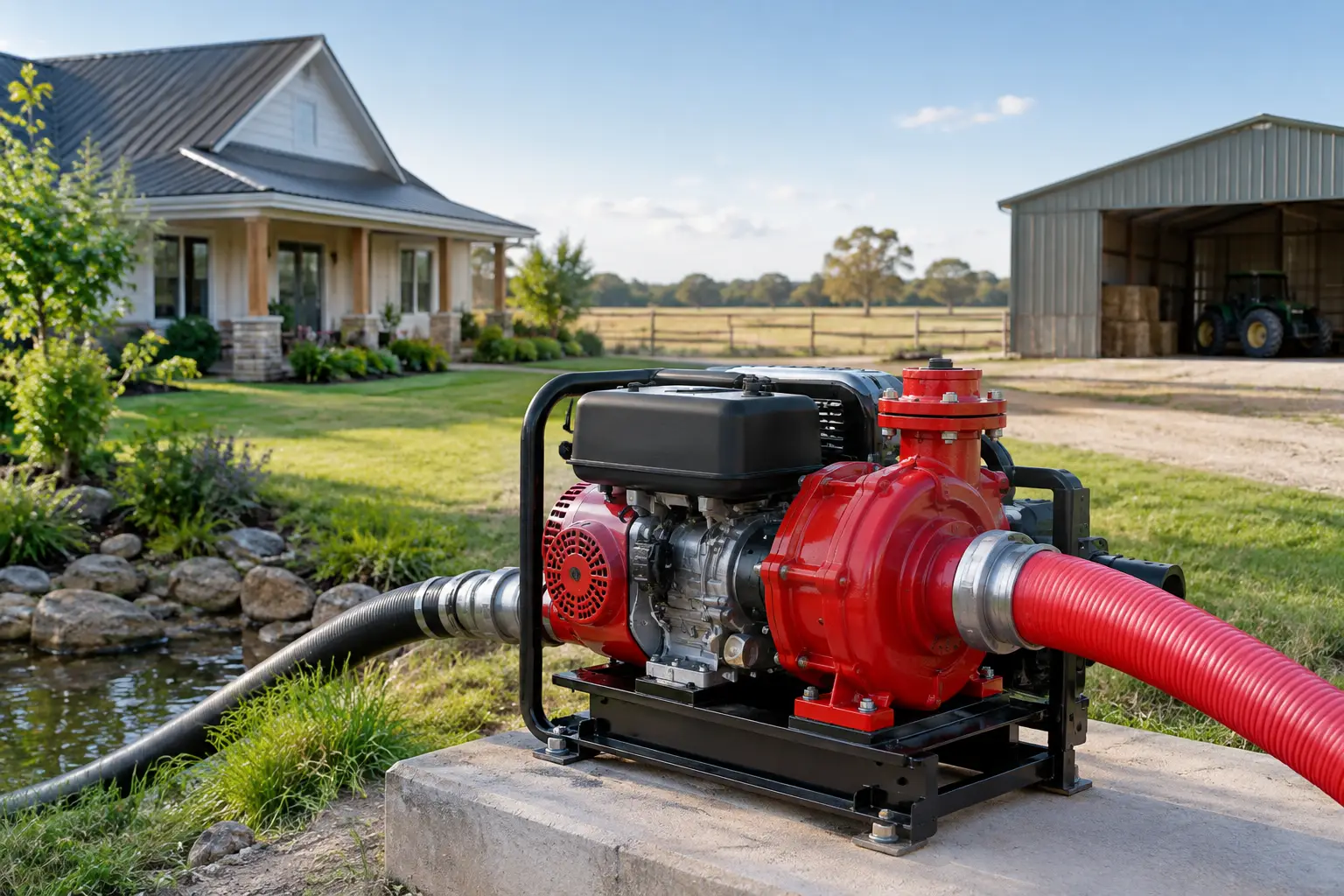
When a grassfire is moving across a neighbouring paddock or embers are landing around a shed, a pump that will not prime or cannot reach the far side of the property is of little use. Fire pumps give homeowners, acreage owners and farm operators a practical way to move stored water quickly for property protection, wash-down and emergency response. The right unit starts with the water you have available, the distance it needs to travel and the fittings already on your tank.
What fire pumps are designed to do
A fire pump is generally a high-flow petrol-powered transfer pump built to draw water from a tank, dam, creek or swimming pool and deliver it through hoses at useful pressure. Unlike a small domestic pressure pump that cycles on and off for taps and toilets, it is intended for rapid water movement when mains power may be unavailable.
For many rural and semi-rural properties, the pump has more than one job. It may fill troughs, shift water between tanks, wash down machinery, run a sprinkler line around a home or provide water during a fire event. That versatility makes it a worthwhile part of a broader water system, provided it is sized for its main purpose rather than bought purely on price.
Petrol-powered units are common because they remain independent of grid electricity. Diesel options can also suit larger operations or sites where diesel is already the preferred fuel. Electric pumps have a place for fixed systems with reliable generator backup, but they need careful planning if bushfire preparedness is the priority.
Choosing fire pumps for your water source
The first question is simple: where will the water come from? A pump can only deliver what the source, suction line and setup allow. Rainwater tanks are an excellent stored supply, but the outlet size, water level and accessibility all matter. A dam or creek may provide greater volume, although dirty water and changing levels create different challenges.
A self-priming pump can pull water through a suction hose after the pump casing has been filled with water. It cannot pull water indefinitely or overcome poor installation. Keep the suction run as short and straight as practical, use a reinforced suction hose rather than ordinary layflat hose, and check every clamp and seal for air leaks. Even a small leak on the suction side can stop a pump from priming properly.
At the water end, fit a foot valve and strainer. The foot valve helps retain water in the suction hose after shutdown, while the strainer keeps leaves, gravel, yabbies and other debris out of the pump. If drawing from a tank, make sure the pickup stays clear of sediment at the bottom. A floating pickup can be useful where water quality varies through the tank.
Tank water also needs to be genuinely accessible in an emergency. A dedicated outlet, clear access to the pump location and compatible fittings are far more useful than a tank connection hidden behind stored equipment or garden growth.
Flow, pressure and head are not the same thing
Pump listings commonly refer to litres per minute, pressure and maximum head. They all matter, but they describe different parts of performance.
Flow is the volume of water moved each minute. It affects how effectively you can fill a tank, supply multiple sprinklers or deliver water through a larger hose. Pressure helps move water through hose, fittings and nozzles, and determines how forcefully water leaves the nozzle. Maximum head is the vertical distance a pump can theoretically lift or push water under stated conditions.
The important figure is performance at your working conditions, not just the biggest number printed on the carton. Every metre of lift, long hose run, narrow fitting, sharp bend and nozzle restriction reduces available output. A pump may look generous on paper but feel underpowered at the end of 60 metres of hose running uphill.
For a compact property with a nearby tank and one hose, a smaller unit may be entirely suitable. A larger home block, farm shed, long driveway or sloping site may justify a higher-capacity pump, larger delivery hose and a properly planned hose layout. Bigger is not always better: larger engines use more fuel, weigh more and can be harder to handle. The sensible choice is the pump that reliably meets the duty required.
Build the system around the pump
A dependable setup is more than an engine and a hose. The pump, suction hose, delivery hose, fittings, nozzle and water storage need to work as one system. Mismatched components are a common reason good pumps perform poorly.
Start by matching hose diameter to the pump ports and intended flow. Reducing a large outlet immediately to a small hose can restrict output. Layflat hose is useful for moving water over distance and packs away neatly, while reinforced hose is better for suction because it resists collapse. Fire hose and quality adjustable nozzles should be chosen for the pressure and connection type of the system.
Consider where the pump will sit. It needs a firm, level position close to the water source, with room to start it, refuel it safely and inspect the hoses. Keep it away from dry grass, fuel containers and obstructions. If it will be stored in a shed, make sure it can be moved into position quickly, or establish a dedicated protected pump point near the tank.
Many property owners also keep a separate domestic pressure pump for household use. This is often the best arrangement. The domestic pump supplies day-to-day water pressure, while the fire pump remains ready for high-volume transfer and emergency use. Trying to make one small household pump do both jobs can leave you short on flow when it counts.
The checks that make a pump useful in an emergency
A pump that has not been run for a year is an unknown quantity. Petrol can go stale, seals can dry out, batteries can fail and spiders can make a home in fittings. Routine testing is the low-cost work that protects the investment.
Run the pump at regular intervals using the actual suction and delivery hoses, not only a quick engine start. Confirm that it primes, holds suction and delivers water through the nozzle. Check engine oil, fuel condition, recoil starter, spark plug, hose clamps, foot valve and strainer. Replace worn seals and perished hoses before the fire season rather than hoping they will last one more summer.
Keep a practical kit with the pump: spare fuel stored correctly, engine oil, a basic tool kit, spare clamps, sealing tape, a replacement fitting and a spare nozzle washer. If the pump uses a battery start, maintain the battery and make sure a manual start method is available.
Water storage deserves the same attention. A large tank is only helpful if there is enough usable water left in it. Review tank levels before summer, especially where rainwater is shared between household use, livestock and irrigation. Some properties benefit from reserving a portion of stored water for emergency use, subject to local rules and the needs of the household.
Fire preparedness needs a property plan
A fire pump is one useful part of preparation, not a reason to stay and defend a property without a considered plan. Follow official emergency advice, monitor warnings and leave early when advised. No pump can make up for poor access, unmanaged vegetation, unsafe fuel storage or a lack of water.
Before fire season, walk the property and identify where hoses can reach, where vehicles can turn around and where the pump can safely operate. Mark tank outlets, keep access tracks clear and make sure everyone who may use the equipment knows how it starts and where the fittings are stored. Builders and renovators should also consider the pump location and hose access while planning sheds, retaining walls, tank pads and landscaping.
If you are installing a dedicated bushfire protection setup, check the requirements that apply to your area, insurer and building project. Connection sizes, static water supply provisions and siting can vary. A pump suited to farm transfer work may not automatically meet every requirement for a specific building or protection system.
Central Coast Water Tanks has been trusted for over 30 years to help customers match tanks, pumps, filtration and fittings into workable water systems, from the coast to country. Buying the right equipment as a coordinated package can save time, avoid fitting mismatches and make future maintenance simpler.
The best time to choose and test a fire pump is when the weather is calm, the tank is accessible and there is no pressure to make it work immediately. Set up the system properly, run it regularly and keep the water path clear. When reliable water matters most, those practical steps give your property a much better starting point.