


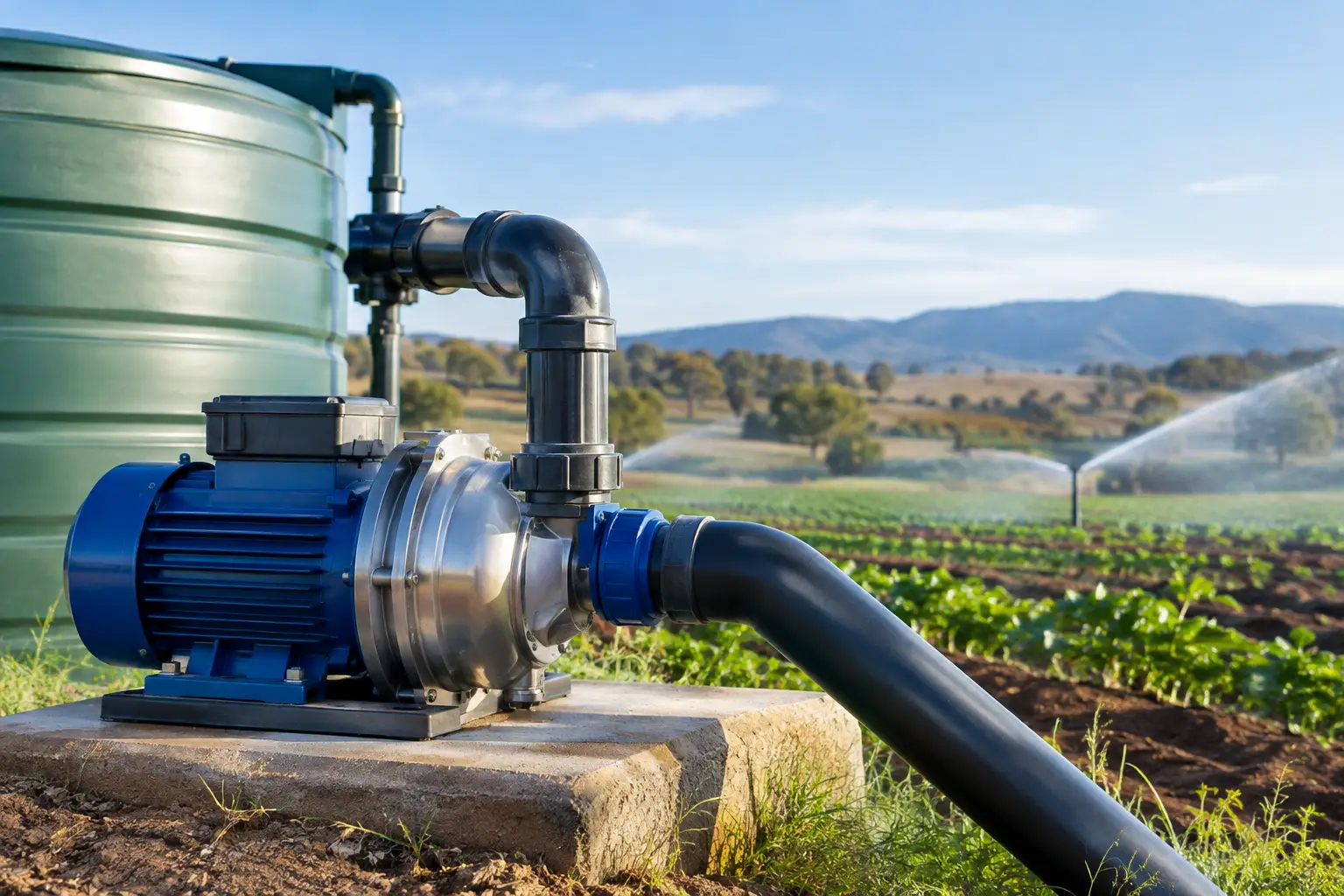
A pump that fills a trough perfectly can be badly undersized for sprinklers across a paddock. Choosing the best pumps for irrigation starts with the job at the outlet, not the size of the water tank or dam. You need enough flow to run the irrigation layout, enough pressure to operate it properly, and a pump designed for the water source and power available on your property.
For a backyard vegetable patch, the answer may be a compact pressure pump. For acreage, livestock watering or a long poly run from a dam, a larger transfer or irrigation pump is often the better fit. Getting this decision right saves water, reduces pump cycling and avoids the frustrating sight of sprinklers barely lifting above the lawn.
What makes a good irrigation pump?
A good irrigation pump delivers its rated flow at the pressure your system actually needs. This sounds simple, but pump specifications can be misleading when viewed in isolation. A pump may advertise a high maximum flow, yet provide much less water once it is lifting from a tank and pushing through 100 metres of pipe to sprinklers.
Start with the irrigation method. Drippers and dripline generally need lower flow and controlled pressure. Spray heads, impact sprinklers and travelling irrigators need more pressure, while a transfer line to a header tank needs volume more than pressure. The best choice depends on which of these jobs the pump will perform most often.
Water quality matters as well. Clean rainwater from a sealed tank is suitable for many domestic-style pumps. Dam, creek or bore water can carry sand, organic matter and fine debris, which calls for appropriate strainers, filters and, in some cases, a pump better suited to dirty water. A quality pump can still fail early if it is fed abrasive water without protection.
Best pumps for irrigation by application
Small gardens and rainwater tanks
For garden taps, hose watering, a few sprinklers or drip irrigation supplied from a rainwater tank, an automatic pressure pump is usually the practical option. These pumps start when water is demanded and stop when the tap or irrigation controller closes. They suit homeowners who want tank water available without manually switching a pump on each time.
Check the pump has enough pressure for the sprinklers you intend to use. A small pump may work well with one sprinkler but struggle with two running at once. If you are connecting a timer or solenoid valves, choose a pump and controller arrangement that can cope with short irrigation cycles without excessive starting and stopping.
Larger lawns, orchards and rural gardens
A multistage pressure pump is often a strong choice where higher pressure is needed for several sprinkler zones, long pipe runs or elevation changes. Multistage pumps use multiple impellers to build pressure, making them useful for systems that need to throw water further or feed irrigation uphill.
They are not automatically the best answer for every property. Higher pressure can be wasteful on dripline unless a pressure regulator is fitted. Match the pump to the zone with the highest demand, then regulate pressure where lower-pressure irrigation is used. This protects fittings and helps deliver more even watering.
Dam, creek and transfer applications
For moving substantial volumes of water from a dam, creek, tank or storage pond, a petrol or diesel transfer pump can be the right tool, particularly where mains power is unavailable. These pumps are popular on farms because they are portable, powerful and straightforward to position near a water source when required.
A transfer pump is excellent at moving water, but it may not provide the pressure needed for fine sprinkler irrigation over a large area. In some systems, it makes sense to use a transfer pump to fill a header tank, then use a separate pressure pump for the irrigation network. This two-stage approach adds equipment, but it can make watering more consistent and simplify pump control.
Remote paddocks and off-grid watering
Solar pumps suit remote troughs, small irrigation zones and locations where running power cables would be expensive. Their output varies with sunlight, so the system should be designed around storage rather than expecting full performance at every hour of the day. Pump water into a header tank during daylight, then gravity-feed troughs or drip irrigation as needed.
For off-grid properties, battery-backed pumps can also be suitable where reliable pressure is required after dark. The right arrangement depends on daily water demand, available solar capacity, lift height and how much water can be stored on site.
Size the pump using flow and head
The two numbers that matter most are flow rate and total head. Flow is usually stated in litres per minute or litres per hour. Total head is the combined resistance the pump must overcome, measured in metres.
To estimate flow, add the demand of all sprinklers, drippers or outlets that will run in one irrigation zone. If each sprinkler uses 12 litres per minute and you run four together, the pump needs to deliver at least 48 litres per minute at operating pressure. Allowing some margin is sensible, especially if filters, long pipe runs or future expansion are part of the plan.
Total head includes more than vertical lift. It is made up of the height from the water level to the highest outlet, the pressure required at that outlet, and friction losses through pipe, bends, valves, filters and fittings. As a useful rule, 10 metres of head is roughly equal to 100 kPa of pressure.
For example, a pump drawing from a tank may need to lift water three metres, provide 250 kPa at the sprinkler, and overcome friction in a long run of poly pipe. That is a very different duty from pumping water to a nearby trough on level ground. Always read the pump curve, not just the maximum head and maximum flow printed on the carton. The required operating point should sit comfortably within the pump’s working range.
Match the pump to the water source
Surface-mounted pumps are generally installed above the water source and draw water through a suction line. They are convenient for rainwater tanks, dams and shallow bores, but suction lift has limits. Keeping the pump close to the water source, using the correct suction hose and maintaining airtight fittings makes a major difference to performance.
Where water levels are deep or the pump must sit in the water, a submersible pump can be more suitable. These are common in bores, pits and some tank applications. They avoid the suction-lift limitations of surface pumps, although installation, cable sizing and service access need to be considered carefully.
Use a foot valve or non-return valve where required to keep the suction line primed. Fit a correctly sized strainer to prevent leaves, sticks and sediment entering the pump. For tank water used through sprinklers or dripline, filtration downstream of the pump is equally important. A blocked filter reduces flow and can make an otherwise capable pump look undersized.
Avoid the common installation mistakes
Most irrigation pump problems are system problems. Undersized suction pipe, too many sharp bends, a leaking suction fitting or a blocked filter can cause poor flow, noise and loss of prime. Never make the suction line smaller than the pump inlet, and keep it short and direct where possible.
Pipe diameter also matters on the discharge side. Long lengths of small-diameter poly create substantial friction loss. Upsizing the main line can sometimes improve real-world irrigation performance more effectively than buying a bigger pump. It also leaves capacity for another zone or extra trough later.
Protect the pump from weather where practical, without enclosing it so tightly that heat cannot escape. Install isolation valves so filters and fittings can be serviced, and use pressure gauges where system tuning matters. If the pump supplies a home as well as irrigation, separate the irrigation zone or use suitable controls so garden watering does not leave the house with poor pressure.
Buy for the system you are building
The cheapest pump is rarely the best value if it cannot meet the duty point or requires replacement after a season of hard work. Look for established pump brands, readily available service parts and a clear warranty. Consider whether you need automatic pressure control, a pressure vessel, dry-run protection, thermal overload protection or a petrol-powered backup for outages.
At Central Coast Water Tanks, our team has been trusted for over 30 years to help customers match tanks, pumps, filters and fittings into practical water systems from coast to country. If you know your water source, pipe distance, lift and irrigation layout, you are already close to selecting the right pump.
Before ordering, sketch the system and write down the flow needed for each zone. That small bit of planning gives you a far better chance of choosing a pump that keeps water moving when the garden, stock or crop needs it most.