


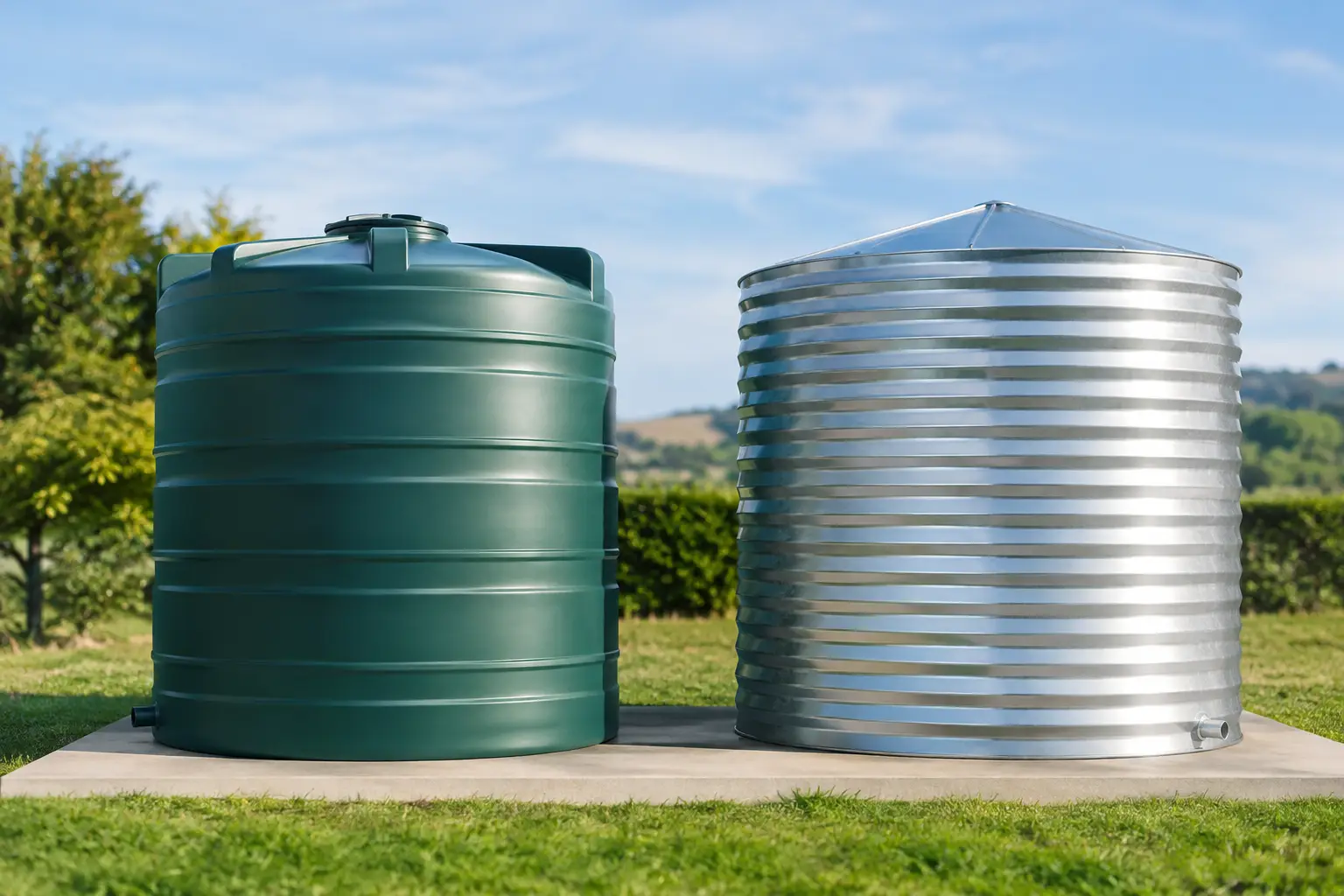
A water tank is not a purchase most property owners want to make twice. Whether you are collecting roof water for a family home, watering stock, supplying a shed or building a fire-water reserve, the choice between poly versus steel tanks affects your available capacity, installation options and long-term costs.
Both materials are proven choices across Australia. The better tank is not simply the one with the biggest capacity or lowest upfront price. It is the one that fits your site, water demand, access and plans for the property. Here is how to make a practical decision.
Poly versus steel tanks: the key difference
Poly tanks are moulded from food-grade polyethylene. They are supplied as one-piece tanks in a wide range of round, slimline and squat shapes. Their major strengths are simple delivery and installation, corrosion resistance and flexibility in tight residential spaces.
Steel rainwater tanks are commonly made from zincalume or galvanised steel with a protective liner, with AquaPlate tanks being a popular option for domestic and rural storage. They are assembled on site from panels and liners, which makes them especially useful when the required tank is too large to transport as a single unit.
In practical terms, poly often suits standard home, shed and small-acreage installations. Steel becomes particularly attractive when you need serious volume, difficult-site access or a tank designed to complement a rural or heritage-style property.
Start with the capacity your property needs
Capacity should lead the decision. A tank that looks right but runs dry after a few weeks without rain will not deliver much value.
For a suburban home using tank water for gardens, toilets, laundry or top-up supply, a slimline or round poly tank can provide useful storage without taking over the backyard. If the tank will supply the whole house, calculate demand carefully and allow for dry periods, roof catchment size and whether town water is available as backup.
On acreage and farms, water use can climb quickly. Livestock, irrigation, wash-down areas and multiple buildings can require tens of thousands of litres. Steel tanks are often selected here because very large capacities can be erected on site. A large tank may cost more initially, but it can reduce the risk of carting water during a dry spell.
Do not choose capacity based only on average rainfall. Consider your longest likely gap between meaningful rain, the number of people or animals relying on the supply, and whether water will be used daily or held mainly for emergency storage.
Where the tank needs to go
Access is one of the clearest dividing lines between poly and steel.
A poly tank arrives as a complete unit, so the delivery ute needs a clear route and enough room to place it. This is straightforward for many new builds, rural blocks and open backyards. It can be harder where there are narrow driveways, low branches, retaining walls, tight side access or established landscaping.
Steel tanks are delivered in components and built where they will stand. This can solve access problems on a constrained block and is a major advantage for big rural tanks. The trade-off is that assembly takes longer and installation needs to be properly coordinated.
Tank shape also matters. A round tank offers excellent storage for its footprint and is usually the most economical way to hold high volumes. Slimline tanks suit side passages and fence lines but store less water for the same length of wall space. Squat tanks can work beneath raised decks or where height is restricted.
Whatever material you choose, the base must be level, stable and correctly sized. A full water tank is extremely heavy. For most installations, that means a prepared concrete slab or compacted base built to the tank manufacturer’s specifications. Skimping on the base is a false economy.
Durability in Australian conditions
Both quality poly and steel tanks are built for Australian weather, but they age differently.
Poly tanks will not rust and do not need an internal liner. Quality tanks use UV-stabilised material to cope with harsh sunlight, and darker colours help block light that can encourage algae growth. They are also less likely to be damaged by small knocks during installation. Over many years, however, constant exposure to intense sun can affect any plastic product, so buying from an established manufacturer and following installation instructions matters.
A steel tank has a strong outer shell, but its performance depends on the coating, liner and roof-water quality. Quality AquaPlate systems are designed for rainwater storage and can provide decades of service when correctly installed and maintained. Check gutters regularly, keep leaf strainers clear and make sure the tank inlet, overflow and mosquito protection are working as they should.
Steel tanks are also well suited to bushfire-prone and open rural locations, particularly where a large dedicated fire-water supply is required. Requirements can vary by council, insurer and bushfire planning rules, so confirm the required capacity, fittings and access before ordering.
Cost: look beyond the tank price
Poly tanks can be a cost-effective option because they are factory-made, quick to install and require fewer on-site assembly steps. For many homeowners, this makes them a sensible way to add rainwater storage without stretching the project budget.
Steel tanks can carry a higher installed cost, especially at larger sizes, due to components, site preparation and assembly. Yet the cost per litre can be very competitive when you move into high-capacity storage. If one large steel tank replaces several smaller tanks, it may also simplify plumbing and pumping.
The full system cost deserves just as much attention as the tank itself. Allow for gutters and downpipes, first-flush devices, strainers, overflow management, fittings, a pressure pump, pipework and filtration where water is used inside the home. A rain-to-mains switch may be worthwhile for households that need automatic backup when tank levels drop.
Buying the tank, pump and filtration components as a matched package can avoid compatibility issues and often delivers better value than chasing individual parts later.
Water quality and intended use
For garden water, stock water and general outdoor use, both poly and steel tanks can perform very well with clean roof catchment and sensible maintenance. If you intend to drink the water, the whole collection and treatment system matters more than tank material alone.
Keep the roof and gutters clean, fit leaf strainers and mosquito-proof screens, and use a first-flush diverter to keep the first dirty roof runoff out of the tank. For drinking water, consider suitable sediment and carbon filtration, with UV filtration where appropriate for the property and water source.
If you are storing something other than rainwater, do not assume a standard water tank is suitable. Chemical, fertiliser, molasses, wastewater and septic applications need purpose-designed tanks with compatible materials, fittings and venting. This is one area where specifying the job correctly at the start protects both your equipment and your water supply.
When poly tanks are the practical choice
A poly tank is often the right fit when you want straightforward rainwater storage for a home, shed, caravan site or small rural property. It is particularly useful where corrosion resistance, quick placement and a choice of colours or slimline shapes are priorities.
Poly is also a good choice when the required capacity is moderate and site access allows a complete tank to be delivered. For many homes connected to town water, a poly tank paired with a pump can reduce reliance on mains water for gardens, toilets and laundry while keeping the project manageable.
When steel tanks make more sense
Choose steel when storage volume is the priority, when access prevents delivery of a large one-piece tank, or when you want a tank assembled on site to suit a large rural application. They are a familiar sight on farms for good reason: a properly specified steel tank can hold substantial reserves for homes, livestock, irrigation and fire preparedness.
Steel can also be the better visual fit for a farm shed, country home or large open block. With the right base, liner and roof-water management, it is a dependable long-term option.
Get the system right, not just the tank
The most successful installations begin with a clear picture of how water moves around the property: roof area, tank location, pump distance, outlet pressure, filtration needs and overflow path. A tank with an undersized pump will frustrate the household. A good pump without enough storage will not solve water shortages.
Central Coast Water Tanks has been trusted for over 30 years to help customers select quality water-storage and water-system products, from coast to country. Before you order, measure the site, estimate your demand and check delivery access. Then choose the tank material that gives your property dependable water when you need it most.