


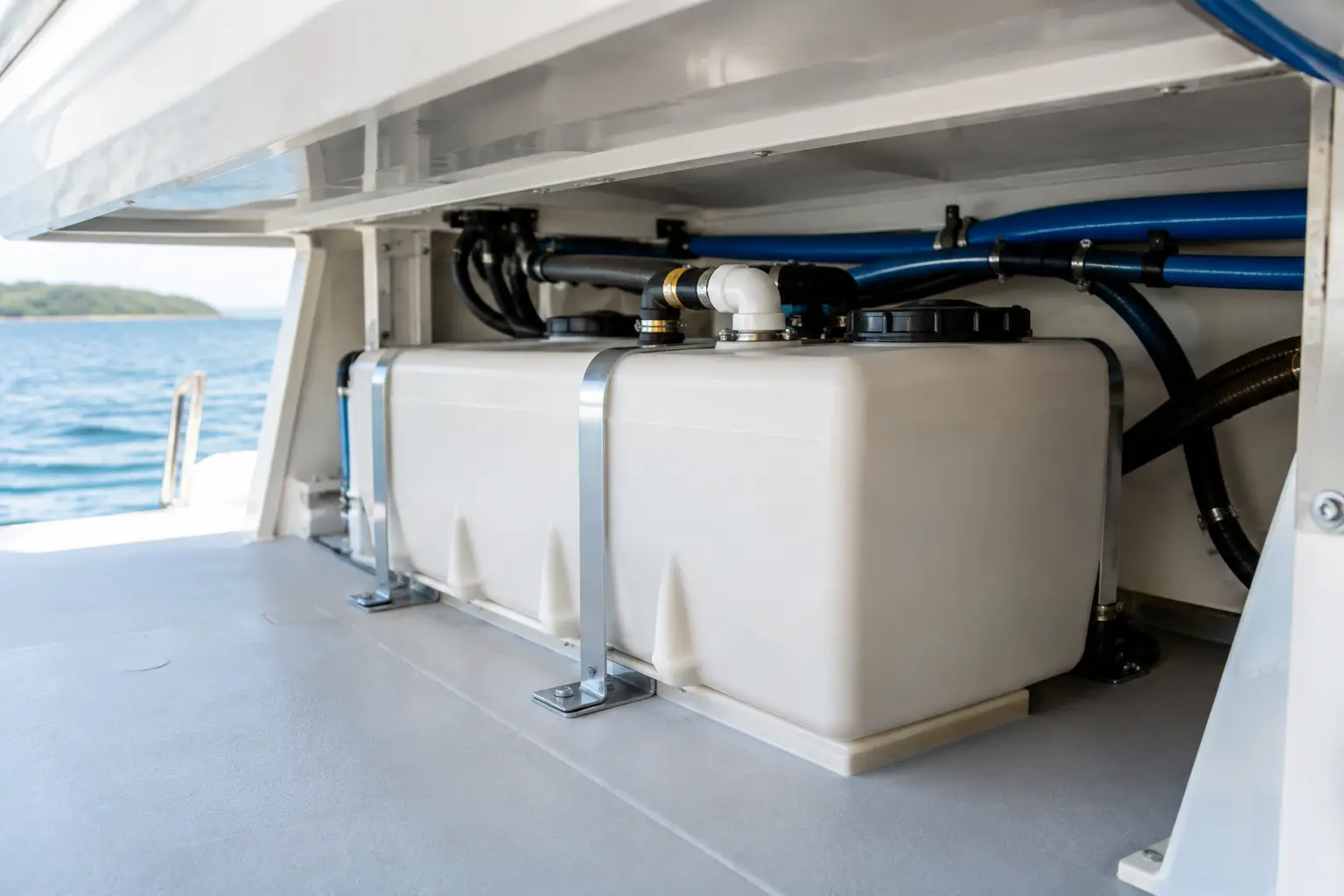
A raised deck can be one of the most useful places on your block – and one of the most overlooked. The shaded area beneath it is often left for stored gear, garden tools and the occasional cobweb. With the right planning, under deck water tanks can turn that otherwise wasted footprint into practical rainwater storage without taking over the yard.
For homes on the Central Coast, in Newcastle, the Hunter Valley and Western Sydney, this can be a particularly good fit. Blocks are getting tighter, outdoor living areas matter, and a reliable water supply is valuable for gardens, toilets, washing machines, sheds or backup household use. The key is choosing a tank and water collection system that suits the height, access and drainage conditions beneath your deck.
Why under-deck storage makes sense
A conventional round rainwater tank is an excellent option where there is clear side access or room near a shed. But on many established homes, that space simply is not available. A slimline or low-profile tank installed beneath a deck can provide worthwhile capacity while keeping pathways, lawns and entertaining areas clear.
The benefit is not just visual. A tank under cover is less exposed to direct sun, which can help limit algae growth when the tank is properly screened and maintained. It is also protected from the knocks that can happen around driveways and busy yards. For renovators, installing the system while a deck is being built can make downpipe routing, access panels and pump locations far easier to organise.
Capacity will depend on the deck dimensions and clearance. A long, low slimline tank may be the sensible answer under a standard timber deck, while a purpose-designed under-deck tank can make better use of a very low space. Do not assume the largest tank that physically fits is automatically the best choice. You still need enough room for fittings, inspection access, cleaning and safe installation.
Start with the available space, not the tank size
Measure the usable area carefully before shopping. Record the width, length and height at several points, especially on sloping sites or older decks where the ground may not be level. Include the space needed for inlet pipes, overflow pipework, outlets and any pump or filter equipment.
Low-profile tanks are designed for restricted heights, but their dimensions vary considerably. Check whether a tank can be manoeuvred into position as well as whether it will fit once installed. Narrow side access, stairs, deck framing and retaining walls can all affect delivery and installation. In some cases, the tank needs to be positioned before decking boards or screening are finished.
Think about future access too. Every rainwater system needs occasional checks. Leaf strainers need cleaning, pump filters may need servicing, and tank screens must remain clear. A neat enclosure is worthwhile, but not if it means dismantling half the deck to reach a simple fitting.
Allow for a proper tank base
A full tank is heavy. One litre of water weighs roughly one kilogram, so a 3,000-litre tank holds around three tonnes before allowing for the weight of the tank itself. That load must sit evenly on a suitable base.
A reinforced concrete slab is often the most dependable option beneath a deck, particularly for permanent residential installations. A properly prepared compacted base may suit some tank types and sites, provided it is level, stable and supported to the tank manufacturer’s requirements. Timber decking boards alone are not a tank base unless the supporting structure has been specifically engineered for the load.
The base should extend across the full tank footprint and remain level over time. An uneven base can place stress on the tank walls and fittings, potentially affecting its service life. This is one area where saving a few dollars upfront can become an expensive mistake later.
Collecting rainwater below a deck
Most under-deck installations collect water from the house roof through existing gutters and downpipes. The downpipe can be diverted to the tank inlet using suitable pipework, ideally with a leaf diverter or rain head ahead of the tank. This stops leaves and larger debris entering the system and makes routine maintenance simpler.
If the deck itself has an under-deck drainage system, that water may also be collected, but it depends on the materials used and the design of the drainage system. Roof runoff is usually the more straightforward source for household rainwater storage. Any collection arrangement should keep contaminants, roof debris and pests out of the tank.
Every tank needs a screened inlet and a correctly sized overflow. Overflow water must be directed away from the deck footings, house slab and neighbouring properties. On a wet coastal block, poor overflow management can cause erosion, ponding or damp areas beneath the house. A charged pipe system can sometimes help where pipe levels are difficult, but it needs careful design and appropriate first-flush management.
Choosing a pump for under deck water tanks
Gravity feed may work for a garden tap positioned below the water level, but most households will need a pump. The right choice depends on what the stored water will supply. A small pressure pump may be suitable for garden watering, while a household pressure system is more appropriate for toilets, laundry use or multiple taps.
Pump location matters beneath a deck. It should be protected from weather, mounted on a stable surface and positioned where it can be accessed for servicing. It also needs adequate ventilation and protection from flooding. A pump sitting in a low corner that regularly gets wet is not a long-term solution.
Noise is another consideration. Pumps can cycle when water is drawn, and a deck can amplify vibration if equipment is fixed directly to its structure. A solid base, flexible connections and sensible positioning can reduce noise around bedrooms and outdoor entertaining areas.
If you want rainwater available inside the home, a rain-to-mains switch can provide a practical backup when the tank runs low. This helps maintain supply to nominated fixtures without manually changing valves. The system should be installed to local plumbing requirements, with suitable backflow protection and no cross-connection between drinking water and non-potable rainwater lines.
Add filtration only where it earns its place
Not every tank needs the same filtration setup. For garden use, a clean tank inlet screen and pump protection filter may be enough. For toilets and washing machines, a sediment filter can help protect valves and appliances from fine particles.
For drinking water, the requirements are higher. Appropriate sediment and carbon filtration, and often UV treatment, may be needed depending on the water source, household use and local advice. Filters only work when cartridges are replaced on schedule, so choose a system with service parts that are easy to identify and obtain.
Common mistakes to avoid
The most common error is treating an under-deck tank as a simple container rather than part of a complete water system. The tank, base, gutters, inlet, overflow, pump, filtration and plumbing all need to work together.
Avoid installing a tank where it blocks access to deck supports, subfloor vents or essential services. Keep the area tidy enough to inspect for leaks and pests. Make sure the deck does not direct dirty runoff, cleaning chemicals or stored materials towards the tank lid or inlet.
It is also worth checking council requirements, building approvals and plumbing rules before work begins. Requirements can differ between local areas and according to whether the water is used outdoors, connected to internal fixtures or intended for drinking. Your installer or licensed plumber can advise on the right approach for your site.
Build a system that suits your property
Under-deck rainwater storage is most effective when it is planned around how you actually use water. A small tank and garden pump can take pressure off mains water for regular watering. A larger tank with a pressure pump, filtration and rain-to-mains backup can support a more complete household setup. On acreage, the same principles apply, though storage capacity and pump performance often need to be scaled up for livestock, irrigation or shed use.
Central Coast Water Tanks has been trusted for over 30 years to help customers choose quality products from coast to country. Matching the tank to the space is only the start. The best value comes from selecting compatible pumps, filters and fittings that will perform together over the long term.
Before ordering, take clear measurements, map the downpipe and overflow route, and decide what you want the stored water to do. A well-planned under-deck tank installation keeps the yard looking open while putting every square metre of your property to better use.