


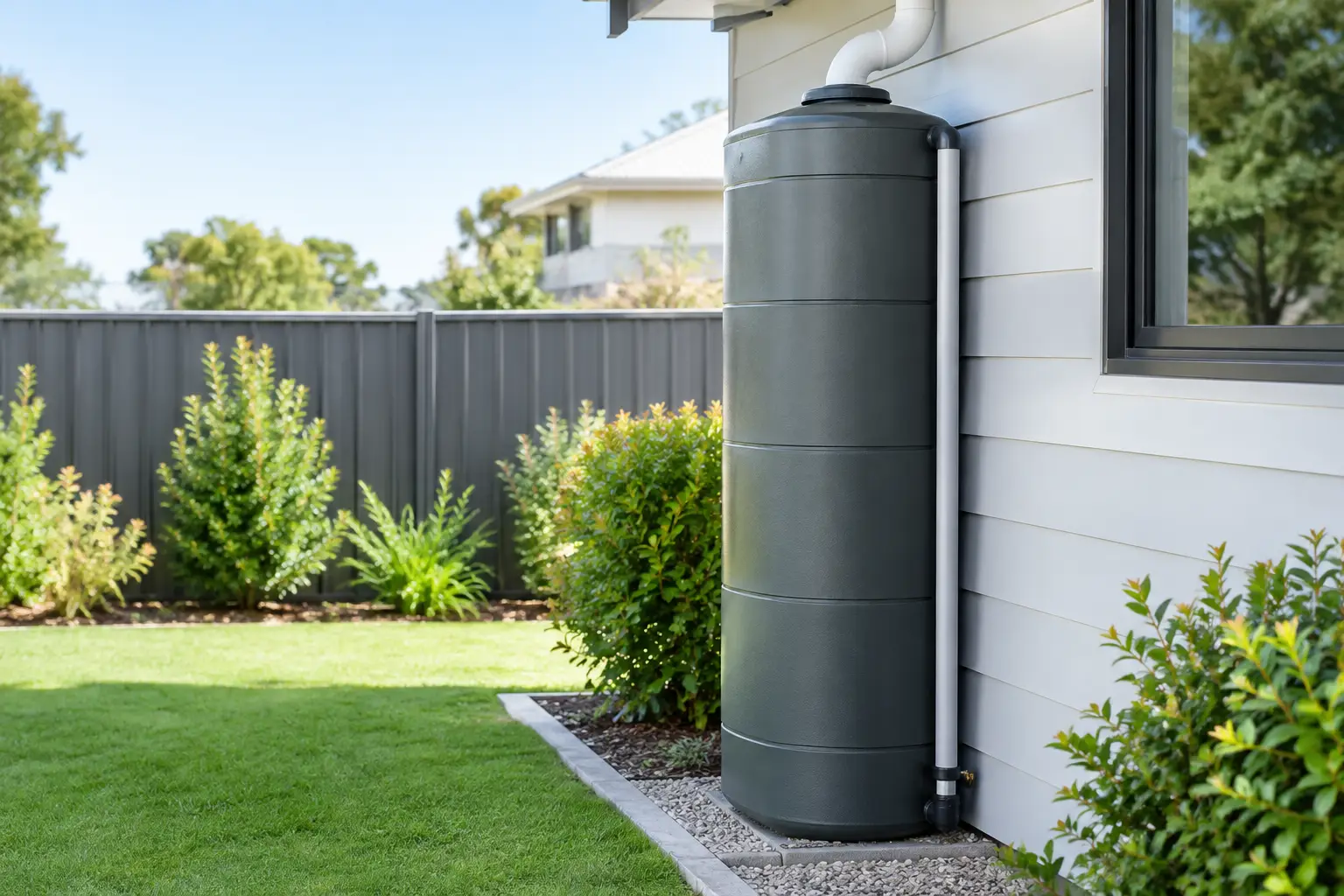
A narrow strip beside the laundry, garage or side fence can hold far more water than most homeowners expect. A slimline water tank for house use is designed for exactly these tight areas, giving you practical rainwater storage without taking over the yard. The right tank can reduce mains-water use for gardens, toilets and washing, or become part of a complete household water supply where rainwater is your primary source.
The key is not simply buying the largest tank that fits. You need enough capacity for your roof catchment and household demand, a safe level base, sensible plumbing and a pump that suits the job. With more than 30 years in the industry, Central Coast Water Tanks knows that a well-matched system saves frustration as well as water.
Why choose a slimline water tank for a house?
Slimline tanks are tall, narrow tanks with a rectangular or oval footprint. Unlike round tanks, which need a clear open area, they sit neatly along walls, down the side of a house, beside a shed or under some raised decks. They are a strong choice for suburban blocks across the Central Coast, Newcastle, Western Sydney and beyond, where space is often the deciding factor.
Their main advantage is placement. By using a side passage or boundary-adjacent area that would otherwise do little, you can keep lawn, access paths and entertaining areas free. Slimline tanks also suit new builds and renovations where the tank location has been planned around downpipes, pumps and outdoor taps.
There is a trade-off. A slimline tank generally holds less water than a large round tank occupying the same broad backyard zone, and its taller shape means the base must be level and fully supported. If your property has the room and you need serious storage for an off-grid home, livestock or broad irrigation, a round poly or steel tank may deliver more litres for the space and budget. For a typical urban home wanting useful rainwater storage in a restricted footprint, slimline is often the sensible answer.
Start with the water you actually need
Tank capacity should reflect how you plan to use the water. A small tank for hand watering and topping up a veggie patch has very different requirements from a system feeding toilets, washing machines and garden taps. If rainwater will supply the whole house, storage needs rise again, particularly for larger families or properties without reliable mains backup.
Your roof area, local rainfall and roof material also affect the result. A large roof can fill a tank quickly during a good coastal downpour, but a small tank can overflow just as quickly. In dry periods, the same tank may be empty within weeks if it is feeding high-demand garden irrigation. Think about the dry spell, not only the wet weekend.
As a practical starting point, consider whether the tank will support one use, several selected uses, or the household supply. It is also worth considering how many downpipes can be connected. A tank linked to only one small roof section may not collect enough water to justify a high-capacity model, while a larger catchment may support multiple slimline tanks joined together.
For homes with limited side access, two or more tanks can be a better solution than searching for one oversized unit. They can be connected through appropriate fittings and installed along separate walls, allowing you to build storage capacity while working around windows, gates and services.
Measure the site before choosing tank capacity
Do not order based on litres alone. Measure the available length, width and height carefully, allowing for the tank, pipework, inlet screen, overflow, tap access and any pump. Check for eaves, meter boxes, air-conditioning units, hot-water systems and gates that need to open. A tank that just fits on paper may be awkward to service once installed.
Access matters as much as the final location. Confirm that a delivery vehicle can reach the property and that there is a clear path for moving the tank into position. Narrow side passages, sharp corners, steps and overhead wires can all change what is practical. It is far easier to confirm dimensions before delivery than to solve an access problem on the day.
The base needs proper attention. A full water tank is heavy, so it must sit on a firm, level and continuous foundation sized to support the entire tank floor. Depending on the product and site, this may be a prepared compacted base, reinforced concrete slab or another approved foundation. Uneven support can stress the tank and affect its warranty, so follow the manufacturer’s installation requirements rather than relying on a few pavers or loose soil.
Allow room around the tank to inspect fittings, clean gutters and service a pump. If it sits close to a boundary, check local council requirements and make sure overflow will not discharge onto a neighbour’s property or create a muddy problem beside the footpath.
Plan the whole rainwater system, not just the tank
A tank only stores the water. To make it useful, the collection and delivery parts need to work together. Rainwater starts at the roof and gutters, then moves through downpipes to a leaf diverter or rain head before entering the tank. A quality inlet screen helps keep leaves and insects out, while an overflow directs excess water safely away when the tank is full.
Mosquito protection is not optional. Screens, sealed inlets and properly managed overflows help prevent pests entering the system. Gutters should also be kept clear, particularly after windy weather or when trees are shedding leaves.
For garden use, a tank outlet and hose tap may be enough if gravity provides adequate flow. Most households, however, benefit from a pressure pump. The right pump depends on the distance to outlets, vertical lift, pipe size and how many taps or appliances may operate at once. A pump that is too small can leave you with poor pressure; one that is oversized may cycle unnecessarily and cost more than needed.
If the tank supplies toilets, washing or household fixtures, speak with a licensed plumber about compliant plumbing and backflow protection. A rain-to-mains switch can automatically move the supply to mains water when tank levels are low, so essential household uses do not stop during a dry spell. This is particularly useful for homes that want the savings of rainwater without manually changing valves.
When filtration should be part of the plan
Rainwater used for gardens, toilet flushing or general outdoor cleaning may only need good collection hygiene and appropriate screening. Water intended for drinking, cooking, showering or whole-house use needs a more considered filtration setup.
The right treatment depends on the water source, roof condition, storage practices and intended use. Sediment cartridges can protect plumbing and improve water clarity, while carbon filtration can address taste and odour. UV filtration is commonly used as part of a properly designed potable rainwater system to treat microbiological risks. Cartridges and UV lamps also need replacement on schedule, so choose a system you can maintain easily.
Do not assume that clear tank water is automatically drinking water. Keep animals and debris off the roof where possible, maintain screens and gutters, and obtain professional advice for potable-water systems. A complete tank, pump and filtration package can make the buying process simpler because the main components are selected to work together.
Common mistakes that cost more later
The most common mistake is choosing a tank around an advertised litre figure without checking the footprint and access. Next is underestimating the importance of the base and overflow. Both can create expensive problems that are avoidable with early planning.
It is also easy to focus on the tank price and forget the total system cost. Include leaf management, pipework, fittings, pump controls, electrical work where required, plumbing, filtration and installation in your budget. Package tank, pump and filter deals can offer better value than sourcing every component separately, especially when you want one supplier for the complete setup.
Finally, be realistic about demand. A slimline tank is excellent for space-saving water capture, but it cannot replace large rural storage where long dry periods, livestock, irrigation or fire preparedness are the main concern. Matching capacity to the property is always better than stretching a small tank beyond its role.
A properly planned slimline system turns an overlooked side space into a dependable water reserve. Measure carefully, choose quality products suited to your use, and set up the pump and filtration from the start so your rainwater works hard for your home, season after season.