


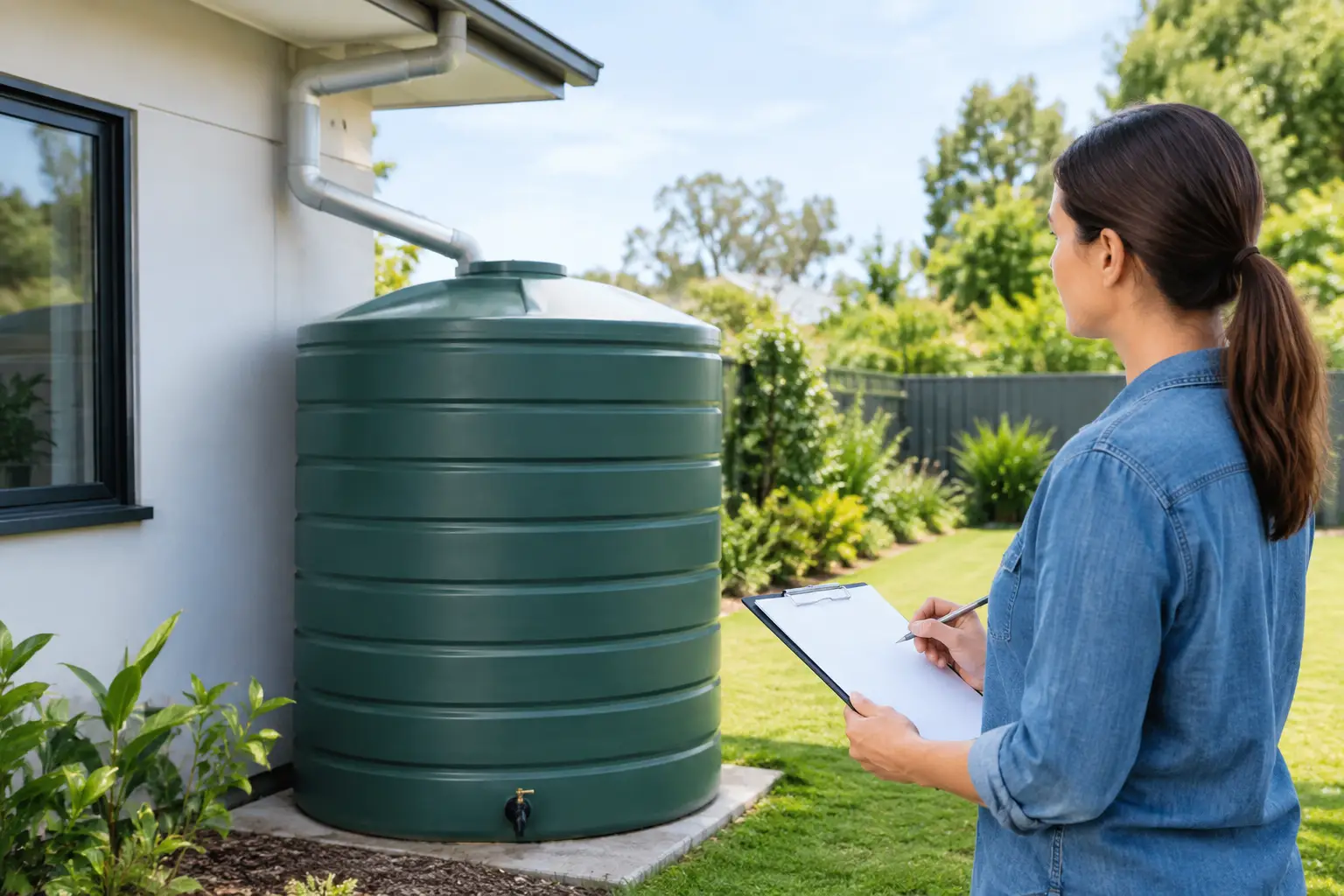
A tank that looks generous in a wet month can be empty halfway through a dry spell. That is why learning how to size rainwater tank storage is about more than picking the biggest model that fits beside the shed. The right capacity needs to match your roof area, local rainfall, household or farm demand, available space and whether mains water is there when the tank runs low.
For a suburban home using rainwater for toilets, laundry and gardens, a modest tank with rain-to-mains backup may be the smart buy. For an acreage home relying on tank water for drinking, showers, stock and fire readiness, storage capacity becomes far more critical. Start with the water you can collect, then compare it with the water you need through the longest likely dry period.
Start with your roof catchment
Your roof is the collection area that determines how much rainwater can reach the tank. As a simple rule, 1 mm of rain falling on 1 square metre of roof produces 1 litre of water. If your roof catchment is 180 square metres and annual rainfall is 900 mm, the theoretical total is 162,000 litres a year.
Not every litre makes it into the tank. Water is lost through first-flush diversion, gutter overflow, wind, evaporation and small leaks or blockages. For practical planning, allow for a collection efficiency of around 80 to 90 per cent on a well-maintained roof, gutters and downpipes. In the example above, usable collection may be roughly 130,000 to 146,000 litres per year.
Annual rainfall figures are useful, but they do not tell the whole story. A property may receive most of its rain in a handful of heavy events, followed by weeks without meaningful rainfall. Tank capacity is what lets you hold water from wet periods for use when the weather turns dry.
Measure the roof, not the house footprint
Measure the horizontal roof area that actually drains to your proposed tank. A complex roof may have several sections, and you may initially connect only one or two downpipes. If a garage, shed or barn roof is also available, include it separately and check whether its water quality suits the intended use.
For potable household water, use clean roofing materials and ensure the catchment is properly maintained. Leaf guards, first-flush diverters and good-quality strainers help protect stored water and reduce maintenance on pumps and filters.
Work out your daily water demand
The second half of how to size a rainwater tank is demand. A tank can only provide reliable supply if its stored volume carries your property through dry weather at the rate you use water.
A water-conscious household often allows around 120 to 180 litres per person per day for general domestic use. That figure can be lower with efficient fixtures and careful habits, or much higher where there are long showers, large families, frequent visitors, irrigation or older appliances. If rainwater supplies only toilets, laundry and garden taps, the demand is much lower than a fully off-grid home using tank water for every tap.
For a family of four using 150 litres each per day, domestic demand is about 600 litres per day. Over 30 days, that is 18,000 litres. Over 60 days, it is 36,000 litres before allowing for garden watering, livestock or water used around a workshop.
Acreage and rural properties need a separate estimate for each water use. Stock requirements vary by animal type, season and feed conditions. Irrigation can quickly exceed household consumption, particularly through hot Hunter Valley or Western Sydney summers. A tank sized for the house will rarely be large enough to also support regular garden or paddock irrigation.
Size storage for the dry spell, not the average year
The most common sizing mistake is to compare annual rainfall with annual household use and assume the numbers are enough. A property might collect more water than it uses across a full year, yet still run out during a six-week dry period.
Consider the longest dry spell you want the tank to cover. If mains water is available through a rain-to-mains switch, you may be comfortable with 14 to 30 days of storage. If the tank is the sole household supply, many owners aim for 60 to 90 days, depending on local conditions, demand and budget. Remote properties may need more reserve again.
Using the four-person example, 60 days at 600 litres a day requires 36,000 litres of usable storage. A 45,000-litre tank gives a sensible buffer for low rainfall, unavoidable water use and sediment below the outlet. If that same family has reliable mains backup and mainly wants to reduce water bills, a 10,000 to 20,000-litre tank may be a more cost-effective fit.
There is no one-size tank capacity for every Australian home. The right answer depends on how much risk you want to carry when rainfall is poor and whether another supply is available.
Match the tank to the site and installation
Capacity is only useful if the tank can be delivered, placed and connected properly. Before choosing a model, check the footprint, height, access path and base requirements. A tall slimline tank may suit a side passage, while a round poly tank often gives the best litres-per-dollar where there is open space. Under-deck and underground tanks can solve tight-site problems, but installation costs can be higher.
The tank base must be level, compacted and fully supported. A full 22,500-litre tank weighs more than 22 tonnes, so this is not a corner to cut. Allow space for downpipes, overflow lines, access to the lid and room to service pumps, filters and fittings.
Also check practical delivery access. Can a truck safely reach the site? Are there low branches, narrow gates, steep driveways or overhead powerlines? It is better to confirm these details before ordering than discover that a larger tank cannot reach its intended location.
Plan the complete system, not just the tank
A tank works as part of a system. For household supply, you may need a pressure pump, pump cover, filtration, a rain-to-mains switch and appropriate plumbing connections. A whole-house filter and UV filtration may be appropriate where tank water is used for drinking, depending on your water quality and treatment needs.
For rural or farm use, think about transfer pumps, irrigation demand, trough float valves and the distance water must travel. A pump that is undersized for the pipe run or elevation will cause poor pressure, regardless of how much water is stored. Fire-fighting storage also needs careful planning, as local council, insurer or bushfire requirements may specify a dedicated reserve, fittings and vehicle access.
When larger storage saves money
A bigger tank costs more upfront, but it can deliver better value where rainfall is seasonal, water use is high or tanker deliveries are expensive. Extra storage means you can capture heavy rain that would otherwise run to overflow. This can be particularly worthwhile on large homes, sheds, barns and rural buildings with substantial roof catchment.
On the other hand, oversizing a tank on a small roof may not solve your supply problem. If the catchment cannot refill it during dry months, the money may be better spent on improving roof connections, adding another catchment area, reducing water use or providing a sensible backup supply.
For many properties, two tanks can be more practical than one large tank. They can fit around buildings, allow staged expansion and provide some reserve if a tank needs cleaning or repair. Connected tanks should be plumbed so water levels balance properly and overflows are managed safely away from building footings.
A practical sizing check before you buy
Bring together four figures: your roof catchment area, local monthly rainfall, expected daily demand and the number of dry days you want to cover. Then assess the tank footprint and the type of backup available. This gives you a far more reliable starting point than choosing capacity based on a neighbour’s tank or an advertised special alone.
Central Coast Water Tanks has been trusted for over 30 years to help customers match quality tanks, pumps and filtration to real property needs, from compact residential setups to large rural water storage. Choosing the right package from the start can save money on upgrades, water cartage and mismatched equipment later.
If your figures sit close to the limit, allow extra capacity where the site and budget permit. Rainfall does not arrive on schedule, and a little more stored water is often the difference between a dependable supply and watching the forecast every morning.